
Ecocapsule on the Ve vatě podcast: Tiny Homes are gaining Popularity across our region
24/07/2026

Less space, lower costs and greater flexibility. Tiny houses and mobile homes are no longer just a weekend getaway. They are increasingly becoming a viable alternative for people looking for a more affordable and flexible way to live. The smallest models are now available from around €30,000.
In a recent episode of Ve vatě, a podcast by Seznam Zprávy, Ecocapsule co-founder Tomáš Žáček discussed how the tiny home trend has evolved, the economics behind micro-living and what lies ahead for Ecocapsule.
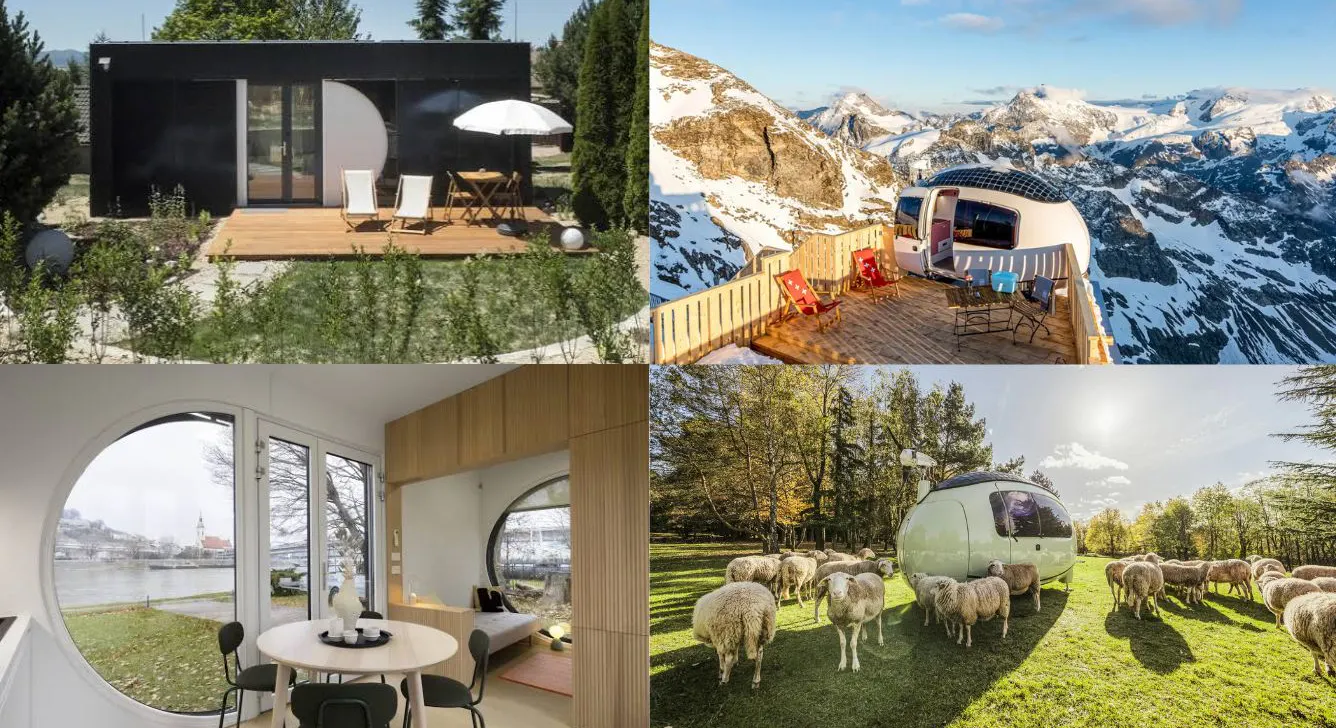
Just a few years ago, Slovakia’s Ecocapsule looked more like a prop from a science-fiction film. The oval-shaped pod, equipped with its own solar power system, wind turbine and rainwater collection system, seemed like a bold technological experiment.
Today, the picture is very different. Compact mobile homes are increasingly appealing to people who do not want to tie their lives to a large property and a long-term mortgage. Instead, they are looking for less space, lower costs and greater flexibility.
Ecocapsule as a self-sufficient home
Designed by Slovak architect Tomáš Žáček and his team, Ecocapsule offers living spaces ranging from 13 to 37 m². Despite its compact footprint, it comes fully equipped with a double bed, kitchenette, dining table, storage space and a bathroom with a shower and toilet. Large windows and a carefully considered layout make the interior feel considerably more spacious than its dimensions might suggest.
Micro-living, however, is not simply a romantic vision of a minimalist lifestyle. Less space also means owning fewer possessions and making efficient use of every centimetre. It therefore requires a different approach not only to housing, but also to consumption.
The original Ecocapsule was designed as an energy self-sufficient tiny home. Electricity is generated through a combination of solar panels and a small wind turbine, while rainwater is collected and filtered for further use. This allows the capsule to operate without relying on a conventional electricity grid connection.
While the original egg-shaped design was priced at around €100,000, the company has managed to significantly reduce costs with its new modular models. Depending on their size and specifications, the new units are now priced at approximately €30,000 to €78,000.
Crowdberry investors backed Ecocapsule’s journey to the global market
Developing a technologically complex product and bringing it to the global market required significant capital. Ecocapsule also earned the backing of Crowdberry investors.
Across several investment rounds, 95 investors provided the company with a total of €2.75 million in growth capital, becoming co-owners of the business.
The investment helped finance further product development, launch small-scale production and support Ecocapsule’s journey from an ambitious technology concept to a fully functional product for the international market.
A new generation of Ecocapsule drives growth and expansion
The original Ecocapsule was a technologically complex and demanding product to manufacture. High development costs combined with low production volumes meant that the company operated at a loss for several years.
A major turning point came with the introduction of a new generation of more affordable and easily scalable modular units in late 2024.
While fewer than 20 of the original capsules were produced — and can now be found in locations ranging from the Caribbean and Japan to the United States — production of the newer modular units has already surpassed 20, providing the foundation for the company’s next phase of growth.
The shift has also translated into improved financial performance. “In 2025, we essentially broke even,” Tomáš Žáček said on the podcast. Ecocapsule expects its results to improve further in 2026, supported by growing sales and international expansion.
A new business model is also playing a key role in the company’s growth strategy. Alongside direct sales, Ecocapsule is beginning to license production and distribution to local partners. The company is currently in discussions over licensed manufacturing in Poland, Germany, Italy, Ukraine and the United States - markets that, according to Žáček, have consistently shown some of the strongest demand for tiny homes.
Watch the full interview with Tomáš Žáček or listen to the Ve vatě podcast on Spotify or Apple Podcasts.
Source: Seznam Zprávy